From Noise to Clarity: How Calm Leadership Turns Confusing Meetings into High-Impact Action
Author: RentReadBuy
Published: 2026-05-28
Learn how calm leadership transforms noisy discussions, emotional debates, scattered feedback, and confusing dashboards into clear priorities, action checklists, and measurable business outcomes.
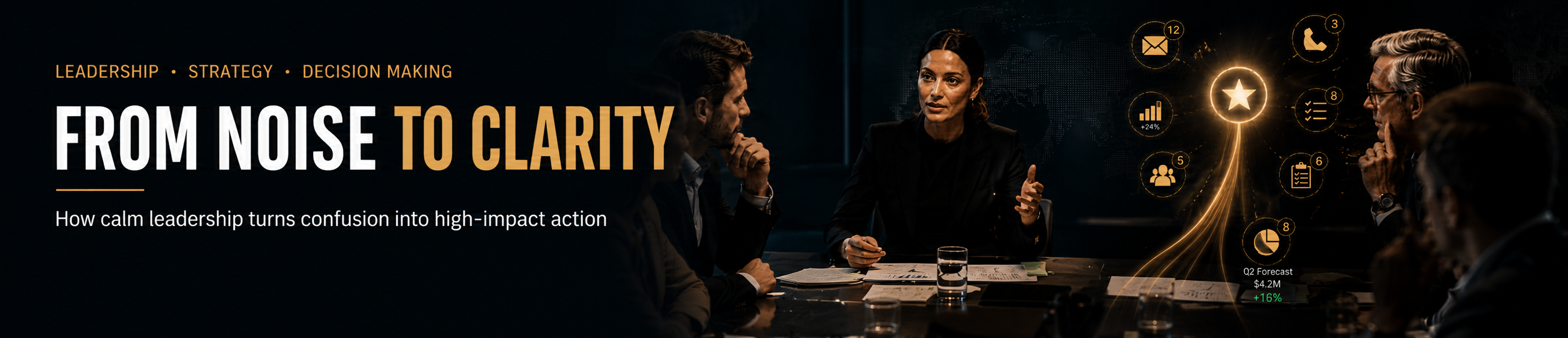
Every business meeting begins with ideas, opinions, urgency, and emotion. But the best leaders do not react to the loudest voice in the room. They listen, pause, separate facts from noise, and guide the team toward one clear priority. This article explores how calm, structured leadership can convert scattered conversations into focused, measurable action.
From Noise to Clarity: How Calm Leadership Turns Confusing Meetings into High-Impact Action
In every growing business, meetings can easily become noisy.
People speak from different perspectives. Sales brings urgency. Operations brings constraints. Finance brings numbers. Technology brings risks. Leadership brings expectations. Everyone may be right in their own way, yet the room can still feel unclear.
This is where real leadership begins.
Not in giving the fastest answer.
Not in dominating the conversation.
Not in defending one idea over another.
Real leadership begins when someone listens carefully enough to find the pattern inside the noise.
The Problem: Too Many Voices, Too Little Direction
Many business discussions do not fail because people lack ideas. They fail because there are too many disconnected ideas at the same time.
One person is talking about growth. Another is worried about cost. Someone else is focused on customer complaints. A dashboard shows numbers, but no one agrees on what those numbers really mean. Notes are scattered. Tasks are half-defined. Priorities keep shifting.
The meeting may look active, but activity is not the same as progress.
When everything feels urgent, teams often make three common mistakes:
They chase too many priorities at once.
They react emotionally to problems instead of studying the facts.
They leave the meeting with discussion points, but no clear ownership or next step.
This creates a cycle where the same issues return again and again.
The Quiet Leader’s Advantage
In the middle of a noisy discussion, the quietest person in the room can sometimes bring the greatest value.
A calm leader does not rush to interrupt. They observe the tone, the data, the hidden concerns, and the repeated patterns. They notice what people are saying - and what they are avoiding.
This pause is powerful.
A short moment of silence gives the leader space to ask better questions:
What is the real problem here?
Which point is emotional, and which point is factual?
What data supports this concern?
Which action will create the highest impact?
Who needs to own the next step?
Calmness does not mean passiveness. It means control.
Step 1: Let the Noise Settle
Before a leader can create clarity, they must allow the noise to settle.
In many meetings, people talk over each other because they feel unheard. When that happens, pushing harder rarely helps. A better approach is to slow the room down.
A good leader may say:
“Let’s pause for a moment. I want to separate the concerns from the facts.”
This small pause changes the energy of the room.
Instead of competing for attention, the team begins to focus. The conversation moves from emotional reaction to structured thinking.
Step 2: Convert Opinions into Data
Every opinion has a source. Sometimes that source is real data. Sometimes it is fear, pressure, past experience, or assumption.
The leader’s job is not to reject emotion, but to translate it.
For example:
“We are losing customers” becomes “What does the retention data show?”
“This process is broken” becomes “Where exactly is the delay happening?”
“We need to hire more people” becomes “Which workload is exceeding capacity?”
“The campaign is not working” becomes “Which metric has dropped — reach, leads, conversions, or revenue?”
This shift is important.
Emotional words create tension.
Facts create direction.
Step 3: Compare Ideas Without Creating Conflict
Healthy disagreement is useful. But unmanaged disagreement can divide a team.
When two ideas appear opposite, a strong leader does not immediately choose sides. Instead, they frame both ideas clearly.
For example:
Option A may focus on market expansion.
Option B may focus on product improvement.
Both may be valid. The real question is not “Who is right?” The real question is:
“Which option creates the highest impact at this stage?”
This changes the conversation from personal preference to business priority.
A respectful comparison helps the team see trade-offs clearly. It also reduces defensiveness because people feel their ideas have been heard.
Step 4: Identify the One Central Priority
One of the biggest reasons strategies fail is that teams try to move in too many directions at once.
Emails, calls, dashboards, customer issues, reports, tasks, and meetings all compete for attention. Everything looks important. But not everything deserves equal focus.
The leader must identify the central priority.
That priority should be based on:
Business impact
Urgency
Available resources
Customer value
Measurable outcome
Execution feasibility
When all floating concerns fade away, one clear question should remain:
“What should we fix or improve first?”
That is where progress starts.
Step 5: Turn the Priority into an Action Checklist
Clarity is not complete until it becomes action.
A strong meeting should not end with vague statements like:
“We need to improve this.”
“Let’s look into it.”
“We should do better next time.”
Instead, the outcome should be an action checklist.
A simple checklist may include:
Review the performance gap and root cause.
Prioritize the highest-impact action.
Assign owners and required resources.
Set deadlines and milestones.
Track progress and adjust weekly.
This turns discussion into accountability.
Step 6: Accept Feedback Without Defensiveness
Another important sign of mature leadership is the ability to receive feedback calmly.
When an error, warning, report, or missed target appears, some teams become defensive. People start explaining, blaming, or protecting their department.
But a calm leader looks at the issue differently.
They see feedback as input.
A red warning is not an attack. It is a signal.
A missed target is not the end of the story. It is a chance to improve the system.
A complaint is not just criticism. It may reveal a hidden gap.
When feedback is treated as useful data, the team becomes more honest, faster, and more resilient.
Step 7: Make People Feel Heard Before Moving Forward
People support decisions more strongly when they feel included in the process.
That does not mean every idea must be accepted. It means every serious concern should be acknowledged.
A good leader may say:
“I understand the concern about cost.”
“That is a valid risk.”
“Let’s include that in the decision criteria.”
“We may not solve everything today, but we will address the highest-impact issue first.”
This approach builds trust.
The team may not agree on everything, but they can still move forward together.
The Real Goal: One Clear Path to Growth
The purpose of leadership is not to remove all complexity. Business will always have complexity.
The purpose of leadership is to create a clear path through that complexity.
When a leader listens deeply, pauses thoughtfully, studies the facts, and prioritizes carefully, the meeting changes.
Noise becomes insight.
Conflict becomes comparison.
Warnings become action points.
Feedback becomes improvement.
Scattered ideas become one focused direction.
And that is how teams grow stronger together.
Final Thought
The most valuable person in the room is not always the one speaking the most.
Sometimes, it is the one who listens long enough to understand the real issue, speaks calmly when the room needs direction, and helps everyone focus on what matters most.
In business, clarity is a competitive advantage.
And calm leadership is often the fastest way to find it.
The most valuable person in the room is not always the one speaking the most.
Sometimes, it is the one who listens long enough to understand the real issue, speaks calmly when the room needs direction, and helps everyone focus on what matters most.
In business, clarity is a competitive advantage.
And calm leadership is often the fastest way to find it.