Three Thousand Stitches by Sudha Murty: Summary, Stories, Themes and Review
Author: RRB Editorial Team
Published: 2026-08-21
A spoiler-light guide to Three Thousand Stitches by Sudha Murty, covering its key stories, major themes, writing style and reasons to read it.
What is Three Thousand Stitches about?
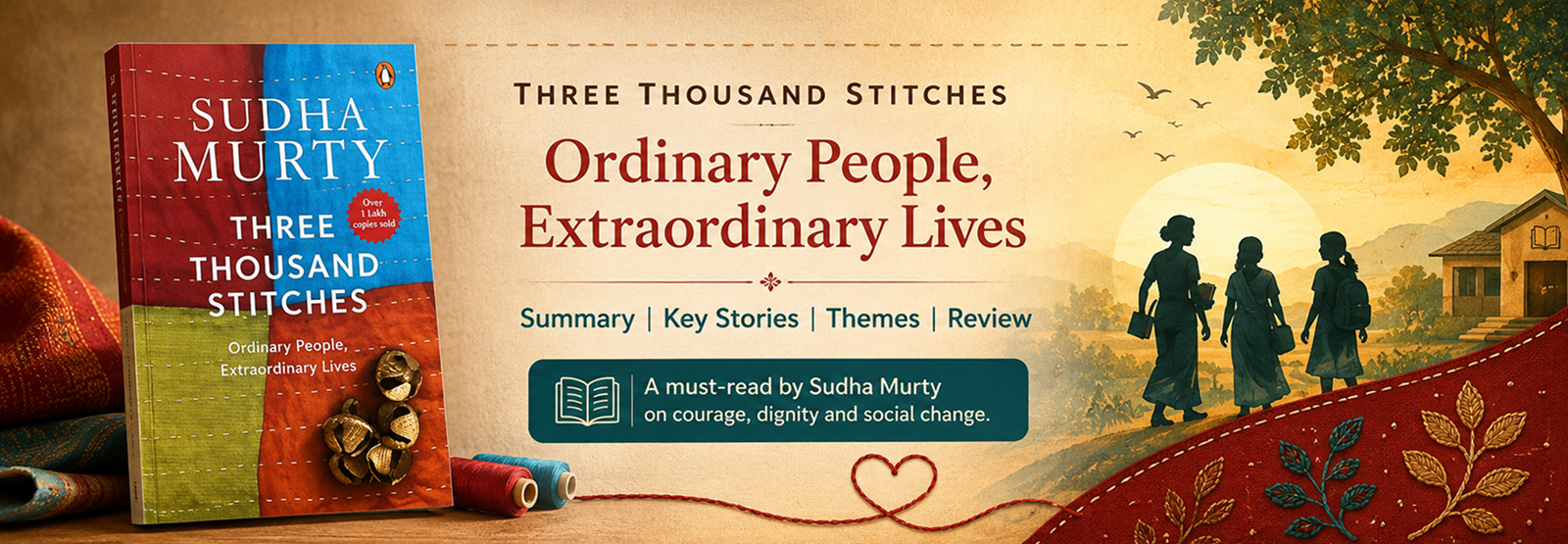
Three Thousand Stitches by Sudha Murty is a collection of 11 real-life narratives drawn from her social work, education, family life and travels. The title story follows her long engagement with women from the devadasi community, while other chapters explore gender bias, social judgement, kindness, Indian culture and the lessons hidden in ordinary encounters.
Readers searching for a Three Thousand Stitches summary often want more than a list of incidents. They want to know what connects the stories, whether the book is suitable for them and whether its message remains meaningful beyond the title chapter.
This spoiler-light guide explains the book's central idea, introduces selected chapters and offers an editorial review without reproducing the complete stories. Readers who want to check the current edition and availability can view Three Thousand Stitches on RentReadBuy.
About Three Thousand Stitches by Sudha Murty
| Full title | Three Thousand Stitches: Ordinary People, Extraordinary Lives |
|---|---|
| Author | Sudha Murty |
| Format | Non-fiction collection of personal narratives and essays |
| Publication | Penguin Random House India, 2017 |
| Length | 256 pages in the listed Penguin edition |
The book is not a novel with one continuous plot. It moves through different periods of Murty's life and work. The publisher describes experiences involving the devadasi community, her years as the only female student in her engineering college, the consequences of her father's kindness and the problem of judging people by appearance.
That structure gives the collection variety. Serious social experiences sit beside memories of education, travel, food, cinema and family. The chapters are connected less by chronology and more by Murty's interest in how ordinary decisions reveal character.
Three Thousand Stitches: spoiler-light summary
The title chapter begins with Sudha Murty trying to work with women from the devadasi community in Karnataka. Her first attempts do not succeed. The women have little reason to trust an outsider who arrives with advice before fully understanding their circumstances.
Instead of treating that rejection as the end of the effort, Murty changes her approach. She listens more carefully, builds relationships and focuses on practical needs such as education, financial independence and collective support. The story's emotional force comes from this gradual movement from suspicion towards trust.
The remaining chapters broaden the book. Murty remembers entering engineering education when women were rarely expected to choose that path. She recounts being judged by her clothing while standing in a business-class queue. She also reflects on family, philanthropy, cultural assumptions and unexpected acts of kindness.
Together, the 11 chapters form a collection about persistence, dignity and the need to look beyond quick social labels. The book does not suggest that every problem has an easy solution. It repeatedly shows that change requires patience, humility and the willingness to revise an ineffective approach.
What does the title Three Thousand Stitches mean?
The title refers to a quilt made by women from the devadasi community as an expression of gratitude. The image of many individual stitches joining to create one complete piece also works as a metaphor for the collection.
A single action may appear small, but repeated efforts can create something durable. In the book, education, trust, courage, financial independence and compassion function like individual stitches. Their combined effect is stronger than any one gesture made in isolation.
Key stories and chapters in the collection
Three Thousand Stitches
The title chapter is the collection's clearest account of social change. Its strongest lesson is that good intentions do not automatically create trust. Sustainable help begins with understanding people, respecting their agency and staying committed after an initial failure.
How to Beat the Boys
Murty looks back at being the only woman in her engineering-college batch. The chapter examines exclusion, limited facilities and social expectations, while showing how persistence and academic performance gradually challenged the assumptions around her.
Cattle Class
This chapter explores class prejudice through an airport encounter in which Murty is judged by her simple clothing. The incident asks readers to separate wealth, appearance and social status from genuine character.
Other chapters
The collection also includes chapters such as Food for Thought, Three Handfuls of Water, A Life Unwritten, No Place Like Home, A Powerful Ambassador, Rasleela and the Swimming Pool, A Day in Infosys Foundation and I Can't, We Can.
These stories widen the book beyond one social-work narrative and allow Murty to reflect on culture, family, responsibility, human behaviour and collective action.
Major themes in Three Thousand Stitches
Dignity before charity
The title story does not reduce people to passive recipients of help. It emphasizes education, participation, financial independence and the right to make choices.
Trust must be earned
Murty's early rejection is central to the book's credibility. It shows that communities with a history of exploitation may have valid reasons to distrust institutions and outsiders.
Education and independence
Education appears both in Murty's own engineering journey and in her social work. It is presented as a route towards confidence, opportunity and greater control over the future.
Gender and social expectations
The collection examines what happens when a woman enters a traditionally male space or refuses to fit an expected social role. The response is not always dramatic confrontation. Sometimes it is disciplined persistence.
The danger of judging by appearance
Several incidents expose assumptions based on clothing, language, money or social position. Murty repeatedly asks readers to evaluate people through conduct rather than presentation.
Small actions can create lasting change
The book finds courage in returning after rejection, helping someone study, performing a duty with compassion and refusing to accept a limiting stereotype. Change is shown as cumulative rather than instant.
Sudha Murty's writing style
Murty writes in a direct, conversational style. The chapters are easy to follow and usually move quickly towards the incident or lesson at their centre. Readers do not need prior knowledge of philanthropy or social policy to understand the situations she describes.
The simplicity is also the source of the book's main limitation. Lessons are often stated clearly rather than left open to interpretation. Readers who prefer subtle literary ambiguity may find parts of the collection instructional. Readers who value accessible reflection are more likely to appreciate the approach.
Who should read Three Thousand Stitches?
- Readers interested in Sudha Murty's life and social work
- People looking for accessible Indian non-fiction
- Readers who enjoy real-life stories with clear lessons
- Students exploring gender, dignity and social responsibility
- Professionals interested in leadership through service
- Book clubs seeking discussion-friendly short chapters
The publisher describes the book as suitable for children and adults. Some chapters address exploitation, discrimination and the devadasi system, so mature teenagers may engage with it independently, while younger readers may benefit from adult guidance.
Three Thousand Stitches book review
The greatest strength of Three Thousand Stitches is its ability to connect large social issues with individual experiences. Exploitation, gender bias and class prejudice can feel abstract when discussed only through definitions. Murty makes them understandable through people, conversations and consequences.
The title chapter is the emotional centre of the collection. Its most valuable element is not only the eventual progress, but the acknowledgement that the first attempt failed. That failure makes the story more useful because it demonstrates that meaningful help requires humility and adaptation.
The variety of chapters is another advantage. Serious experiences sit beside college memories, travel observations and moments of humour. This makes the book approachable and gives readers space between heavier subjects.
The collection is less successful when its conclusions feel too neatly stated or when a complex issue receives only a brief treatment. Readers seeking a deeply researched social history will need other sources. This is primarily a personal and reflective collection.
Editorial verdict
Three Thousand Stitches is a warm, readable and thought-provoking collection about dignity, persistence and the patient work required to create change. It is especially suitable for readers who appreciate Indian non-fiction, short reflective chapters and stories that connect personal responsibility with social impact.
Should you rent or buy Three Thousand Stitches?
Renting can be a practical first choice when you want to explore Sudha Murty's non-fiction before deciding whether the book belongs in your permanent collection. Buying may suit readers who plan to revisit the chapters, annotate them or share the book with family members.
For a wider decision framework, read when renting a book may make more sense than buying it. New readers can also see how RentReadBuy works.
Read the complete stories
Check the current rental and purchase availability of Three Thousand Stitches before placing an order.
Check current availabilityYou can also browse more Sudha Murty books on RentReadBuy or explore books available to rent or buy.
Publisher and book references
Editorial note: Book availability, rental pricing and purchase pricing may change. Check the RentReadBuy product page for current details before ordering.