World Youth Skills Day 2026: 5 Future-Ready Skills You Can Build Through Books
Author: RentReadBuy Editorial Team
Published: 2026-07-14
AI tools can generate answers, but young people still need focus, judgement, leadership and technical understanding. Explore five RentReadBuy books that can help build future-ready skills for the AI age.
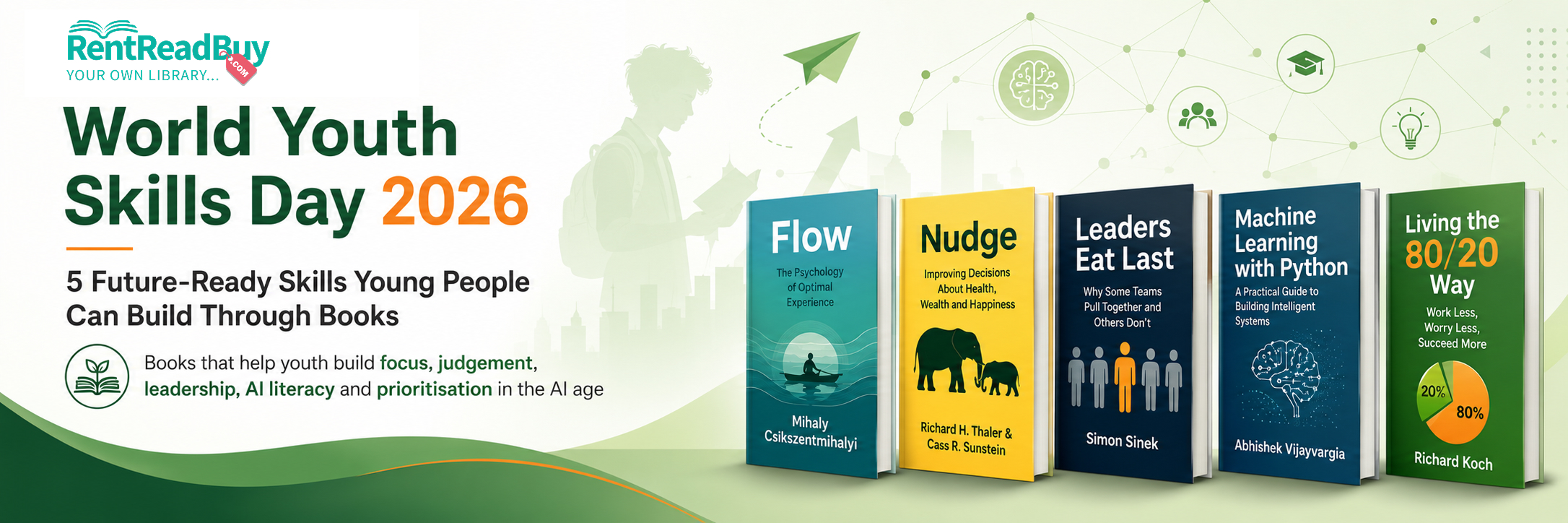
World Youth Skills Day 2026: 5 Future-Ready Skills Young People Can Build Through Books
Published on 14 July 2026 | RentReadBuy Editorial Team | Approx. reading time: 12 minutes
Artificial intelligence can generate answers, summarise documents, write code and prepare presentations within seconds. However, succeeding in the AI age requires more than knowing how to use an AI tool. Young people still need focus, judgement, technical understanding, empathy, leadership and the ability to decide what deserves their attention.
Article summary
World Youth Skills Day is observed on 15 July. The official theme for World Youth Skills Day 2026 is “Skills for a Shared Future.”
The theme recognises that young people need a balanced combination of digital, technical, social-emotional and civic capabilities. In an AI-driven world, knowing how to access information is useful, but knowing how to evaluate, apply and communicate that information is even more important.
This article recommends five books available on RentReadBuy that can help young people strengthen:
- focus and deep engagement;
- critical judgement and decision-making;
- leadership, empathy and collaboration;
- machine-learning and data literacy; and
- prioritisation and intentional productivity.
Key takeaways
- AI literacy is important, but it must be supported by critical thinking and human judgement.
- Books allow readers to follow complete arguments rather than relying only on shortened answers or summaries.
- Focus, leadership, empathy and decision-making remain valuable even when routine work becomes automated.
- Technical reading can help young people understand how AI systems work instead of treating them as unexplained tools.
- Renting a book can make it easier to explore a new skill before deciding whether to buy a permanent reference copy.
Five books for five future-ready skills
| Book | Author | Primary skill | Benefit in the AI age |
|---|---|---|---|
| Flow | Mihaly Csikszentmihalyi | Focus and deep engagement | Helps readers concentrate beyond notifications, prompts and continuous task-switching. |
| Nudge | Richard H. Thaler and Cass R. Sunstein | Decision-making | Helps readers recognise biases, defaults and the ways digital choices are presented. |
| Leaders Eat Last | Simon Sinek | Leadership and trust | Develops empathy, teamwork, responsibility and human-centred leadership. |
| Machine Learning with Python | Abhishek Vijayvargia | AI and data literacy | Introduces the concepts, processes and practical methods behind machine learning. |
| Living the 80/20 Way | Richard Koch | Prioritisation | Helps readers identify the skills and actions that create the greatest value. |
Why reading still matters when AI provides instant answers
AI is changing how students learn and how professionals work. Used responsibly, generative AI can help explain difficult concepts, create practice questions, organise information and support personalised learning.
However, faster output does not automatically mean deeper learning.
The OECD Digital Education Outlook 2026 explains that generative AI can support learning when it is guided by clear educational principles. It also cautions that outsourcing tasks to AI may improve immediate performance without creating equivalent learning gains.
UNESCO’s work on artificial intelligence in education promotes a human-centred approach that combines technological opportunity with inclusion, ethics, equity and responsible capability.
A book asks the reader to remain with an argument across several chapters. It provides context, examples, limitations and connections that may disappear from a short AI summary. Reading also gives young people time to question an idea and form an independent interpretation.
The purpose of reading in the AI age is not to compete with technology. It is to build the judgement required to use technology intelligently.
1. Flow: Build the ability to concentrate deeply
Author: Mihaly Csikszentmihalyi
Primary skill: Focus, engagement and intrinsic motivation
Young people have access to more learning resources than ever before. They can watch tutorials, join online courses, generate notes, ask AI questions and search for explanations instantly.
The challenge is no longer limited to finding information. It is also about remaining focused long enough to understand and apply it.
In Flow, psychologist Mihaly Csikszentmihalyi explores the experience of becoming completely involved in a meaningful activity. A flow state usually occurs when a task has a clear goal and provides a level of challenge that stretches a person’s existing ability without becoming unmanageable.
AI can make tasks faster, but it can also encourage constant movement between prompts, tabs, applications and suggested outputs. Young people still need sustained attention to understand difficult concepts, learn programming, analyse AI-generated responses and complete substantial projects.
This book can help readers understand how goals, challenge, feedback and personal ability affect concentration. These ideas are useful for students preparing for examinations, young professionals developing new capabilities and creators working on demanding projects.
- Choose one important skill or project.
- Define one clear outcome for a 45-minute learning session.
- Remove unnecessary notifications and browser tabs.
- Keep AI available for specific clarification, but do not ask it to complete the entire task.
- At the end, explain what you learned without using AI.
2. Nudge: Understand how decisions are influenced
Authors: Richard H. Thaler and Cass R. Sunstein
Primary skill: Decision-making, behavioural awareness and critical judgement
Every digital platform influences decisions. The order of search results, the position of a button, a default subscription, a recommended video and a personalised suggestion can all affect what a person chooses next.
Nudge examines how choices are shaped by the way they are presented. It explains that people do not always make decisions through completely rational analysis. Habits, biases, defaults and the surrounding choice environment can influence behaviour.
AI systems increasingly recommend what people should read, watch, purchase, study and apply for. These recommendations may be useful, but they are not automatically neutral, complete or perfectly aligned with the user’s long-term interests.
Young people should learn to ask:
- Why was this recommendation shown to me?
- What information or alternative may be missing?
- Is the system optimising for my benefit, my engagement or a commercial outcome?
- Am I choosing thoughtfully or following the easiest default?
- What assumptions are present in this AI-generated advice?
- Have I compared the response with a credible independent source?
Reading Nudge can help young people recognise how digital environments shape behaviour. This awareness is relevant to online shopping, personal finance, social media use, education, health choices and career planning.
Maintain a decision journal for seven days. For each important digital decision, record:
- the decision you made;
- how the available options were presented;
- the default or easiest option;
- whether an algorithm or AI system influenced you; and
- whether you would make the same choice after reviewing it.
3. Leaders Eat Last: Develop the human skills technology cannot replace
Author: Simon Sinek
Primary skill: Leadership, empathy, trust and collaboration
Young people do not need to wait for a management title before learning leadership. Leadership begins when someone takes responsibility, listens carefully, helps a group work through uncertainty and creates an environment in which other people can contribute confidently.
In Leaders Eat Last, Simon Sinek explores why some teams develop trust and cooperation while others become divided by fear, internal competition and self-interest. One of the book’s central ideas is the “Circle of Safety,” an environment in which team members feel supported and can direct their energy toward shared challenges.
AI can help organise tasks, prepare meeting notes, analyse performance information and draft communications. However, it cannot replace the lived human experience of trust, responsibility and belonging within a team.
Future workplaces will still need people who can:
- understand concerns that are not expressed clearly;
- handle disagreement respectfully;
- take responsibility when something fails;
- recognise when a colleague needs support;
- communicate difficult decisions with empathy;
- balance performance with fairness; and
- consider how AI-enabled decisions affect real people.
- Ask team members what support they need.
- Make responsibilities and deadlines visible.
- Address mistakes without humiliating the person involved.
- Share credit openly.
- Review how the team worked, not only what it delivered.
4. Machine Learning with Python: Understand the technology behind AI tools
Author: Abhishek Vijayvargia
Primary skill: Machine learning, data literacy and technical understanding
There is an important difference between using an AI product and understanding the principles behind it.
A person may be able to generate text, images or code without understanding how data, models, training, classification, prediction and evaluation work. This can make AI systems appear more reliable or mysterious than they actually are.
Machine Learning with Python introduces machine-learning concepts using mathematical explanations, Python examples and practical datasets. Its coverage includes Python and Jupyter, feature engineering, data visualisation, regression, classification, neural networks, text analysis, recommendation systems and time-series analysis.
Not every young person needs to become a machine-learning engineer. However, a basic understanding of AI and data can help students and professionals become informed users rather than passive consumers of automated outputs.
This understanding can help young people:
- distinguish conventional rules-based software from machine-learning systems;
- understand why data quality affects model quality;
- recognise that model outputs are based on patterns and probabilities;
- question how training data may introduce bias;
- understand why a model may perform well in one situation and poorly in another;
- communicate more effectively with technical teams; and
- evaluate AI outputs with greater realism.
- Understand what each field in a small public dataset represents.
- Clean missing or inconsistent data.
- Visualise important patterns.
- Choose a basic regression or classification technique.
- Evaluate the output.
- Record where the model makes mistakes.
- Explain why those errors may have occurred.
5. Living the 80/20 Way: Focus on the skills that create the greatest value
Author: Richard Koch
Primary skill: Prioritisation, personal effectiveness and intentional learning
The AI age offers almost unlimited learning possibilities. A student can try coding, design, data analysis, digital marketing, finance, content creation and dozens of AI tools at the same time.
Trying to learn everything often results in completing very little.
Living the 80/20 Way applies the principle that a relatively small number of actions frequently produce a large share of meaningful results. The book encourages readers to identify what is genuinely important instead of confusing constant activity with progress.
AI tools can increase productivity, but they can also increase the number of possible tasks. Young people need to distinguish between tools that support a defined goal and tools that simply create more activity.
Without clear priorities, young people may spend too much time:
- testing every newly launched AI application;
- collecting courses they never complete;
- generating plans they do not implement;
- producing large amounts of low-value content;
- changing career direction whenever a new trend appears; or
- learning individual tools without developing an underlying capability.
A student interested in data analytics may gain more long-term value from consistently improving statistics, spreadsheets, SQL, visualisation and communication than from briefly experimenting with 30 unrelated AI products.
- Which skills directly support my main career or academic goal?
- Which two skills would make the others easier?
- Which activities produce visible progress?
- Which activities only make me feel busy?
- Which AI tools genuinely save time or improve learning?
- What can I pause for the next 30 days?
How these five books work together
- Flow helps you remain engaged with a difficult task.
- Nudge helps you examine how choices are shaped.
- Leaders Eat Last helps you work responsibly with people.
- Machine Learning with Python helps you understand AI and data more deeply.
- Living the 80/20 Way helps you decide what deserves your time.
Technical knowledge without judgement can lead to careless decisions. Productivity without empathy can damage teams. AI access without concentration can encourage shallow learning. Leadership without technological understanding can create unrealistic expectations.
Young people are more likely to thrive when they combine technological capability with thoughtful human judgement.
A practical 30-day reading and skill-building plan
You do not need to complete all five books in one month. Select the book that addresses your most immediate need and use the following structure.
Week 1: Understand
- Read the introduction and important opening chapters.
- Write the author’s central argument in your own words.
- Identify one idea that challenges your current behaviour.
- Use AI to question your interpretation rather than replace the reading.
Week 2: Apply
- Select one practical idea from the book.
- Use it during study, work or a personal project.
- Record what changed.
- Note where the idea was difficult to apply.
Week 3: Evaluate
- Compare the author’s advice with another credible source.
- Identify the assumptions behind the advice.
- Consider situations in which the recommendation may not work.
- Discuss the idea with a teacher, colleague, friend or mentor.
Week 4: Build
- Turn the most useful lesson into a repeatable habit.
- Create a small project based on the skill.
- Explain the lesson without using AI assistance.
- Decide whether the book should be revisited, recommended or added to your permanent collection.
Should young people rent or buy skill-development books?
Buying a book can be valuable when it is likely to become a long-term reference or a title the reader expects to revisit regularly.
Renting can be a practical choice when a reader is:
- exploring a new subject;
- comparing several books;
- uncertain whether a title matches their current level;
- reading for a short academic or professional project;
- trying to reduce the cost of experimentation; or
- avoiding the accumulation of books they may not revisit.
RentReadBuy gives readers the flexibility to explore books through rental and buy titles they want to retain.
How to use AI responsibly while reading books
The most productive approach is not “books versus AI.” It is using books together with responsible AI assistance.
1. Ask for clarification
After reading a difficult passage, ask AI to explain the idea using a different example. Compare the explanation with the author’s original argument.
2. Test your understanding
Write your own explanation first. Then ask AI to identify gaps, unclear assumptions or possible counterarguments.
3. Create practice situations
Ask AI to generate a case study in which the book’s principle can be applied. Work through the case before asking for a suggested answer.
4. Compare perspectives
Ask for an opposing viewpoint, but verify important claims through credible and preferably primary sources.
5. Turn ideas into projects
Use AI to help structure a small experiment or project. Complete the work yourself and evaluate what actually happened.
Frequently asked questions
What is the theme of World Youth Skills Day 2026?
The official theme is “Skills for a Shared Future.” It focuses on equipping young people with a balanced range of capabilities needed to participate as learners, workers, citizens and agents of positive change.
Why should young people read books when AI can summarise them?
A summary gives selected conclusions. Reading the complete book allows the reader to follow the author’s reasoning, examine examples, identify assumptions and form an independent interpretation. AI can assist this process, but it should not automatically replace it.
Which book should a student read first?
- Choose Flow when concentration is the main difficulty.
- Choose Nudge to improve decision-making and digital awareness.
- Choose Leaders Eat Last to develop teamwork and leadership.
- Choose Machine Learning with Python to understand AI and data.
- Choose Living the 80/20 Way when prioritisation is the main challenge.
Can reading a book alone create a professional skill?
Reading develops concepts, methods and perspective. A dependable professional skill develops when reading is combined with practice, projects, feedback and real-world application.
Is renting useful for students and young professionals?
Renting makes it easier to explore subjects without purchasing every title immediately. It is especially useful when testing a new career direction, comparing authors or reading for a short-term learning objective.
Research and reference sources
Build skills that help you work with AI—not depend entirely on it
AI will continue to become faster and more capable. That does not make human learning less important. It makes the quality of human judgement more important.
This World Youth Skills Day, do not try to learn everything at once. Select one skill that matters to your future. Choose one book. Apply one lesson. Complete one real project.
Explore the recommended books on RentReadBuy:
- FLOW: The Psychology of Optimal Experience
- Nudge: Improving Decisions About Health, Wealth and Happiness
- Leaders Eat Last
- Machine Learning with Python
- Living the 80/20 Way