10 Benefits of Reading Aloud to Children Every Day
Author: RentReadBuy Editorial Team
Published: 2026-07-31
Discover how shared reading supports vocabulary, comprehension, confidence, empathy and parent-child connection, plus a practical 15-minute routine.
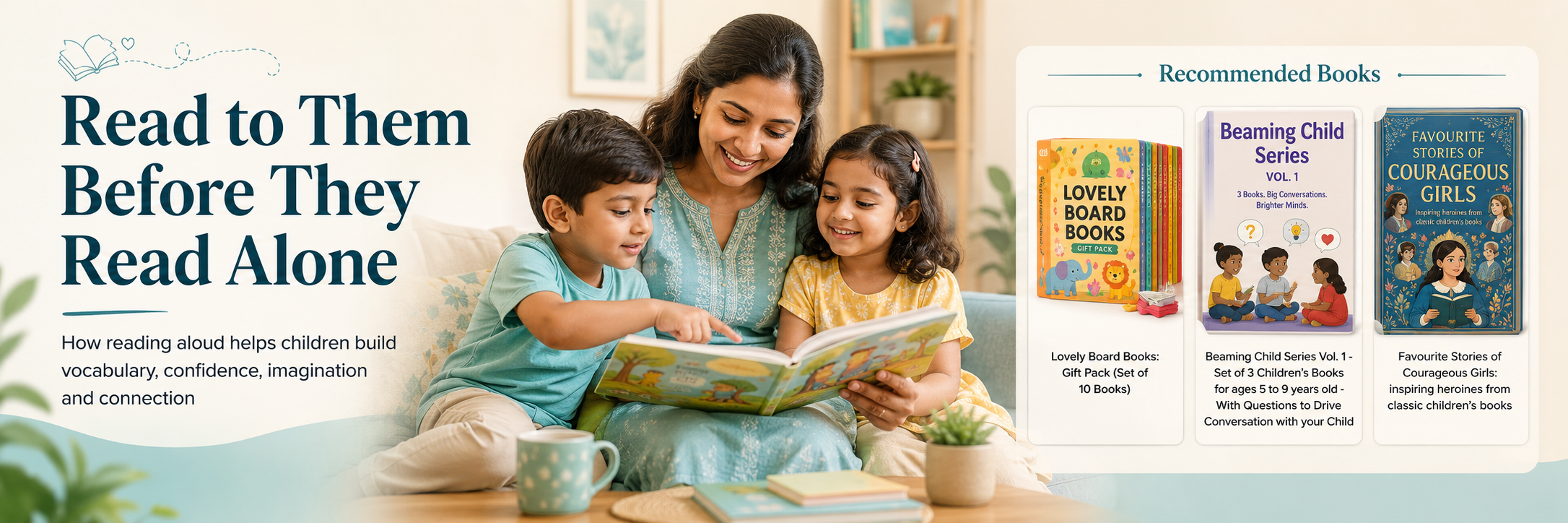
Many parents stop reading aloud as soon as a child can recognise words independently. It can feel as though shared reading has completed its job. In reality, learning to decode words is only one part of becoming a reader.
Children still benefit from hearing expressive language, discussing ideas, meeting unfamiliar vocabulary and enjoying stories that may be above their current independent reading level. Reading aloud is not a replacement for independent reading. It is a supportive experience that can continue alongside it.
Quick answer: The benefits of reading aloud to children include stronger vocabulary, listening comprehension, imagination, emotional understanding, reading confidence and parent-child connection. A short, interactive routine repeated regularly is usually more useful than a long session that feels forced.
What parents should remember
- Shared reading can begin in infancy and continue after a child reads independently.
- Conversation, expression and connection matter more than performing every word perfectly.
- A practical 10–15 minute routine is a starting point, not a compulsory rule.
- Older children can enjoy chapter books, biographies, articles and nonfiction read together.
- Book choice should reflect the child’s interests, maturity and current confidence.
The American Academy of Pediatrics describes shared reading from birth as a language-rich activity that also supports close, nurturing relationships. Research on read-aloud interventions has likewise found positive effects on oral language and print knowledge, particularly when adults make the experience interactive rather than simply reading through the pages without conversation.
Why is reading aloud important for children?
When an adult reads aloud, the child is free to concentrate on meaning, rhythm, characters and ideas without carrying the entire burden of decoding. This creates space for richer conversation and allows the child to experience books that might be difficult to read alone.
The importance of reading aloud to children is therefore broader than teaching letters or pronunciation. Shared reading combines language exposure, attention, emotional connection, curiosity and enjoyment in one simple family activity.
10 benefits of reading aloud to children
1. It introduces richer vocabulary
Books often contain words, sentence patterns and expressions that do not appear frequently in everyday conversation. Hearing these words within a story gives children clues about their meaning and shows how language works in context.
Try this: Explain only the words that are important to understanding the story. Too many interruptions can break the flow, while one short explanation can deepen it.
2. It strengthens listening comprehension
Listening to a story requires children to remember what happened earlier, follow a sequence, connect causes with consequences and notice how characters respond. These are comprehension skills, even when the child is not reading the printed words independently.
Try this: Pause at one meaningful moment and ask, “What do you think might happen next?”
3. It supports early literacy and print awareness
Young children gradually notice that books have titles, pages turn in a sequence, printed words carry meaning and sounds connect with letters. These early observations help prepare them for later reading instruction.
Try this: Let toddlers hold the book, turn pages, point to pictures and repeat familiar words or sounds.
4. It makes more complex books accessible
A child’s listening comprehension can be stronger than their independent decoding ability. Reading aloud lets children enjoy longer plots, more sophisticated vocabulary and unfamiliar subjects with adult support.
Try this: Choose a book that is interesting but slightly beyond what the child would comfortably read alone, and share it a chapter at a time.
5. It develops imagination and narrative thinking
As children listen, they construct places, actions and characters in their minds. They also begin to understand how stories are organised around a beginning, a problem, a sequence of events and an outcome.
Try this: Before showing the next illustration, ask the child what they imagine the scene might look like.
6. It helps children understand emotions and perspectives
Stories give children a safe way to explore disappointment, friendship, courage, jealousy, kindness and mistakes. Talking about a character can be easier than discussing the child’s own experience directly.
Try this: Ask, “Why do you think the character reacted that way?” rather than asking only whether the behaviour was right or wrong.
7. It strengthens parent-child connection
Shared reading creates a period of focused attention in which the parent and child look at the same thing, respond to one another and experience a story together. For many families, the routine also becomes a calm transition before bedtime.
Try this: Keep the phone away for the short reading window so the child receives your full attention.
8. It builds reading confidence
Children who struggle to decode every word can still take part by listening, predicting, describing pictures or reading one manageable sentence. This allows them to experience success without making the entire session a test.
Try this: Alternate pages, paragraphs or character voices according to the child’s confidence.
9. It makes reading interactive and memorable
Expression, humour, pauses and conversation bring printed words to life. The child is more likely to remember a new idea when they have reacted to it, connected it with experience or explained it in their own words.
Try this: Use different voices sparingly, invite the child to repeat a funny line and revisit favourite passages without worrying about finishing quickly.
10. It creates a positive reading habit
Children are more likely to return to books when reading is associated with warmth, choice and enjoyable conversation. A predictable shared-reading ritual can make books feel like part of family life rather than another academic task.
Try this: End while the child is still interested and let them help choose what will be read next.
Benefits of reading aloud to young children
For babies, toddlers and preschoolers, the parent’s voice is part of the learning experience. The child hears language patterns, connects words with pictures and learns that books invite attention and conversation.
Reading aloud to young children does not require completing a full story. A baby may listen for two minutes, a toddler may return repeatedly to the same page and a preschooler may ask questions that move far beyond the printed text. These are not interruptions to literacy. They are part of shared reading.
For very young children: repetition is useful. Reading the same familiar book again can strengthen recognition, participation and confidence, even when adults are ready for something new.
Does reading aloud benefit older children too?
Yes. The benefits of reading aloud to older children are different from the earliest literacy benefits, but they remain valuable. Older children can listen to books above their independent reading level, encounter unfamiliar subjects and discuss choices, motives and consequences in greater depth.
Shared reading with older children can include:
- taking turns with a chapter book;
- reading a biography, article or short story together;
- listening to an audiobook while following the printed text;
- sharing one interesting passage rather than completing a whole chapter; or
- discussing how a book connects with history, science, sport, current interests or personal experience.
The key is to avoid making the older child feel that reading aloud is evidence that they are incapable. Present it as a shared experience, just as adults may listen to podcasts, audiobooks, speeches or performances.
Reading aloud vs screen time: what is the real difference?
It would be too simplistic to claim that every book experience is automatically better than every screen experience. Video calls, creative tools, educational programmes and accessible digital content can all have value.
What shared reading reliably offers is responsive human interaction. A parent can notice confusion, answer a question, follow the child’s curiosity, slow down, repeat a passage and connect the story with the child’s life. Many passive screen experiences provide fewer opportunities for this back-and-forth exchange.
A study of 12- and 24-month-old children found positive associations between shared book reading and vocabulary, while greater screen time was negatively associated with vocabulary among the 24-month-old group. Because the study was observational, it should not be treated as proof that one activity directly caused the outcome. The practical lesson is to protect time for conversation-rich activities rather than treating reading as a punishment after a device is removed.
For a broader family plan, read How to Reduce Screen Time in Children Without Daily Battles.
A simple 15-minute read-aloud routine
There is no universal scientific rule that every child must be read to for exactly 15 minutes. The following routine is simply a manageable starting point for busy families. Adjust it according to age, interest and the natural length of the story.
| Time | What to do | Why it helps |
|---|---|---|
| 0–2 minutes | Let the child choose from two or three suitable books. Look at the cover and title. | Choice builds ownership without creating overwhelm. |
| 2–10 minutes | Read with natural expression. Pause only when curiosity or meaning requires it. | The story retains momentum while the child hears fluent language. |
| 10–13 minutes | Ask one or two light questions about a prediction, feeling, fact or funny moment. | Conversation supports comprehension without turning the session into a test. |
| 13–15 minutes | Invite the child to retell one part, choose a favourite page or decide what to read next. | The child finishes as an active participant and has a reason to return. |
How to make reading aloud interactive
Interactive reading does not mean stopping after every sentence. The aim is to respond to the child and create a small amount of meaningful conversation.
Before reading
Look at the cover, read the title and ask what the child notices or expects.
During reading
Pause at natural moments for a prediction, explanation or emotional reaction.
After reading
Ask what was surprising, funny, confusing or worth remembering.
Helpful prompts include:
- “What do you notice in this picture?”
- “What might happen next?”
- “Why do you think the character did that?”
- “Have you ever seen or felt something similar?”
- “Which part would you change?”
- “What would you like to find out after this?”
Families can read in the language in which conversation feels most natural. The quality of shared meaning and interaction matters more than forcing the entire session into a language that makes both parent and child uncomfortable.
How to choose read-aloud books by age
| Age or stage | Good starting formats | How to involve the child |
|---|---|---|
| Babies and toddlers | Board books, rhymes, familiar objects, animals, colours and repeated phrases | Point, name, imitate sounds and allow repeated pages |
| Ages 3–5 | Picture books, humour, everyday situations, friendship and simple problems | Predict events, describe illustrations and repeat favourite lines |
| Ages 6–8 | Illustrated chapter books, folktales, mysteries, animals and accessible nonfiction | Alternate pages, discuss new words and recap the previous chapter |
| Ages 9–12 | Adventure, fantasy, history, biography, science, mythology and longer fiction | Discuss motives, ideas, evidence and connections with real life |
| Teenagers | Articles, speeches, essays, short fiction, biographies and selected novel passages | Share interesting passages and allow disagreement without turning it into an assessment |
For more detailed guidance on maturity, reading level and interest, read How to Choose the Right Books for Kids by Age.
Common reading-aloud mistakes to avoid
- Turning every page into a lesson. Children need room to enjoy the story without answering a comprehension question after every paragraph.
- Correcting every pronunciation immediately. During shared pleasure reading, constant correction can damage flow and confidence.
- Choosing only overtly educational books. Humour, fantasy, mystery and imaginative stories also build language and engagement.
- Stopping as soon as the child can read alone. Independent reading and listening to a more demanding story can develop together.
- Using a strict timer when the child is engaged. Fifteen minutes is a practical starting point, not a reason to stop in the middle of an enjoyable moment.
- Keeping the selection unchanged for too long. Repetition is valuable, but fresh books can help when interest begins to fade.
Three RentReadBuy options for shared reading
The right choice depends on the child, but these three verified RentReadBuy titles provide useful options across different stages.
Lovely Board Books: Gift Pack
Ten sturdy, colourful books covering familiar early-learning subjects. Suitable for pointing, naming, repetition and short toddler or preschool reading sessions.
View this book setBeaming Child Series Vol. 1
Three illustrated stories set in a contemporary Indian context, with themes such as compassion, gratitude and resilience plus questions that can support conversation.
View this story setFavourite Stories of Courageous Girls
An anthology featuring courageous heroines from well-known children’s literature. The varied extracts can help older children discover classics through manageable shared-reading sessions.
View this anthologyWhy rotating books can keep shared reading interesting
Some books become family favourites and deserve to be read repeatedly. At the same time, children’s interests and abilities change quickly. A wider rotation can introduce new subjects, formats, characters and levels of challenge.
Renting can help families:
- try several age-appropriate formats without buying every title first;
- rotate stories when interest begins to fade;
- experiment with fiction, nonfiction, humour, classics and illustrated books;
- support more than one child at different reading stages; and
- buy the books children repeatedly request or genuinely want to keep.
Explore the RentReadBuy book library, or learn how renting and returning books works.
Final thought: read with them, not only to them
The most valuable read-aloud session is not necessarily the one in which the adult performs every voice perfectly or finishes the greatest number of pages. It is the one in which the child feels involved, curious and comfortable returning tomorrow.
Begin with one suitable book and a short daily window. Let the child choose, pause for genuine conversation and continue shared reading even as independent reading grows. Fifteen calm minutes today can become the beginning of a much longer relationship with books.
Find a story worth sharing tonight
Explore picture books, story collections, chapter books and family favourites without buying every title first.
Explore the Book LibraryHelpful references: American Academy of Pediatrics policy on literacy promotion; synthesis of read-aloud interventions; shared reading quality and brain activation study; and shared reading, screen time and vocabulary study.