How to Choose the Right Books for Kids by Age: A Practical Guide for Parents
Author: RentReadBuy Editorial Team
Published: 2026-07-21
A practical guide to selecting age-appropriate books that help children develop strong reading habits while making reading enjoyable.
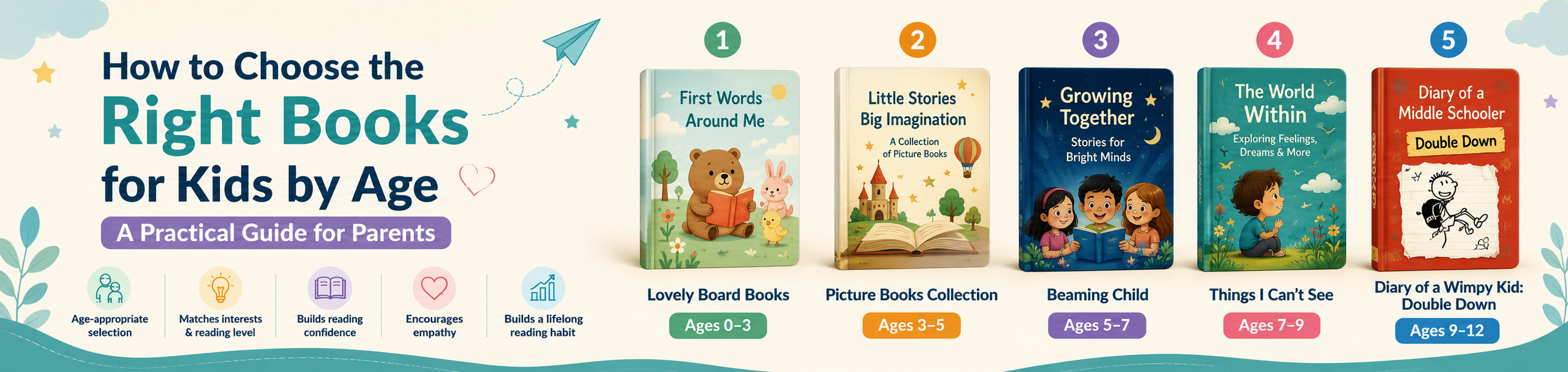
Choosing the right books for children is not simply about checking the age printed on a cover. A suitable book should match the child’s current reading ability, interests, emotional maturity and attention span. The right choice can make reading enjoyable, while a book that feels too difficult or uninteresting may quickly discourage a young reader.
Quick guidance for parents: Use age as a starting point, not as a strict rule. Observe what your child understands, enjoys and willingly returns to.
Why age-appropriate book selection matters
Children develop reading skills at different speeds. Two children of the same age may have different vocabulary, confidence and comprehension levels. Reading involves word recognition, fluency, comprehension and motivation, so book selection should consider all of these factors rather than age alone.
A well-matched book helps a child:
- understand the story without constant frustration;
- learn new words in a meaningful context;
- develop confidence as an independent reader;
- connect reading with curiosity and enjoyment; and
- build a regular reading habit .
Parents looking for further guidance can review Reading Rockets’ guide to choosing a child’s book .
How to choose books for children by age
Ages 0–3: Board books and visual discovery
Babies and toddlers usually respond best to sturdy board books with bright pictures, familiar objects and very short text. Repetition, rhythm, animal sounds and everyday vocabulary help them connect spoken language with images.
Look for:
- thick, durable pages;
- clear pictures with limited visual clutter;
- colours, shapes, numbers, animals and common objects;
- rhymes and repeated words; and
- books that invite pointing, naming and conversation.
Suggested from RentReadBuy
Lovely Board Books: Gift Pack (Set of 10 Books) introduces preschool children to alphabets, numbers, colours, fruits, animals, vehicles and other familiar subjects.
View Lovely Board BooksAges 3–5: Picture books and simple stories
Preschool children are beginning to follow simple story sequences. Choose books with expressive illustrations, predictable patterns and characters experiencing situations that children recognise, such as friendship, family routines, sharing or starting school.
Look for:
- one clear idea or event per page;
- large, readable text;
- humour, rhyme and repetition;
- stories that encourage questions; and
- topics linked to the child’s daily life.
Suggested from RentReadBuy
Picture Books Collection for Early Learning (Set of 12) covers alphabets, numbers, fruits, flowers, animals, shapes, colours and good habits through simple visual learning.
View Picture Books CollectionAges 5–7: Early-reader books
Children in this age group often begin reading short sentences independently. Books should provide enough challenge to support progress without making every page feel like a test.
Look for:
- short paragraphs and manageable chapters;
- illustrations that support understanding;
- familiar vocabulary with a few new words;
- clear beginning, middle and ending; and
- characters and problems children can discuss.
Suggested from RentReadBuy
Beaming Child Series Vol. 1 contains three illustrated stories for children aged 5–9, exploring compassion, empathy, gratitude, resilience and hard work.
View Beaming Child SeriesAges 7–9: Developing independent readers
As reading confidence grows, children can handle longer plots, a wider vocabulary and more complex emotions. This is also a good stage to introduce humour, mysteries, biographies, science, mythology and stories from different cultures.
Look for:
- short chapter books;
- strong characters and engaging plots;
- a balance of fiction and nonfiction;
- topics connected to the child’s interests; and
- stories that encourage empathy and discussion.
Suggested from RentReadBuy
Things I Can’t See uses everyday emotional situations to help children recognise feelings, consider hidden reasons behind behaviour and build empathy.
View Things I Can’t SeeAges 9–12: Broader themes and longer books
Older children are often ready for longer chapter books, complex relationships and subjects that require reflection. Let them explore several genres instead of assuming that every child should enjoy the same type of story.
If your child is becoming curious about Indian history, biographies and the freedom movement can be a meaningful next step. Explore our guide to the best books on Indian freedom fighters to discover biographies, first-hand writings and broader historical reading options.
Look for:
- adventure, humour, fantasy, history and realistic fiction;
- books featuring meaningful choices and consequences;
- nonfiction linked to hobbies or school subjects;
- characters with whom the child can identify; and
- stories that invite discussion rather than deliver a forced lesson.
Suggested from RentReadBuy
Double Down: Diary of a Wimpy Kid Book 11 offers humour, school-life situations and an accessible chapter-book format for confident independent readers.
View Diary of a Wimpy Kid: Double DownReading level matters as much as age
An eight-year-old may enjoy a story intended for younger readers, while another child of the same age may be ready for longer novels. Neither situation is automatically a problem. The aim is to maintain understanding and enjoyment while gradually introducing appropriate challenges.
One simple informal check is the five-finger rule: ask the child to read a page and raise one finger for every unfamiliar word. If there are around five or more unfamiliar words on a page, the book may require more adult support rather than being the best choice for fully independent reading. This is only a quick guide; comprehension, interest and confidence should also influence the decision. You can learn more from this guide to finding “just right” books .
Let your child’s interests guide the choice
A technically suitable book may still remain unread if the subject does not interest the child. Some children love dinosaurs, space or experiments. Others prefer humour, animals, sport, mythology, mysteries or real-life stories.
Offer two or three suitable choices and let the child make the final selection. This creates ownership and reduces the feeling that reading is another compulsory task.
Do not confuse difficult books with better books
Parents sometimes choose advanced books because they believe harder material will accelerate learning. In practice, repeated difficulty can reduce confidence. A child should have access to:
- comfortable books they can read independently;
- slightly challenging books that stretch their skills; and
- read-aloud books that may be above their independent level but can be enjoyed with an adult.
For children who have age-appropriate interests but read below the expected level, high-interest and lower-reading-level books can provide mature topics in a more accessible format. More information is available in this overview of high-interest, low-reading-level books .
Use renting to discover what your child genuinely enjoys
Children’s interests can change quickly. Buying every book before knowing whether the child will enjoy it can lead to unused books and unnecessary expense. Renting allows families to experiment with different authors, formats and genres before deciding which books deserve a permanent place on the shelf.
RentReadBuy allows readers to explore books online, select suitable titles and receive them through doorstep delivery. Browse the RentReadBuy book catalogue to explore available titles, or see how RentReadBuy works before choosing your next book.
Help your child discover their next favourite book
Explore different subjects, reading levels and formats without buying every book first.
Browse books on RentReadBuyA practical checklist for parents
| Check | Question to ask |
|---|---|
| Age suitability | Is the subject and presentation appropriate for my child’s maturity? |
| Reading level | Can my child understand most of the text without constant help? |
| Interest | Does the topic genuinely appeal to the child? |
| Format | Would pictures, short chapters, comics or nonfiction work better? |
| Representation | Does the reading collection include different people, cultures and experiences? |
| Enjoyment | Is the child eager to continue reading or talk about the book? |
Common mistakes to avoid
- Choosing only by age label: Age ranges are useful guides, but reading ability and interest should also influence the decision.
- Rejecting picture books too early: Richly illustrated books can support comprehension and discussion even for older readers.
- Forcing one genre: A child who dislikes fantasy may enjoy facts, humour, sport, comics or biographies.
- Correcting every mistake: Constant interruption can turn shared reading into a stressful exercise.
- Using reading only for academic improvement: Children also need space to read for pleasure, curiosity and relaxation.
Final thoughts
The best book for a child is not necessarily the most advanced, expensive or popular title. It is the book that creates curiosity, feels manageable and encourages the child to continue reading.
Begin with age guidance, check the reading level, consider the child’s interests and provide a varied selection. When children are allowed to discover what they genuinely enjoy, reading is more likely to become a lasting habit rather than another obligation.