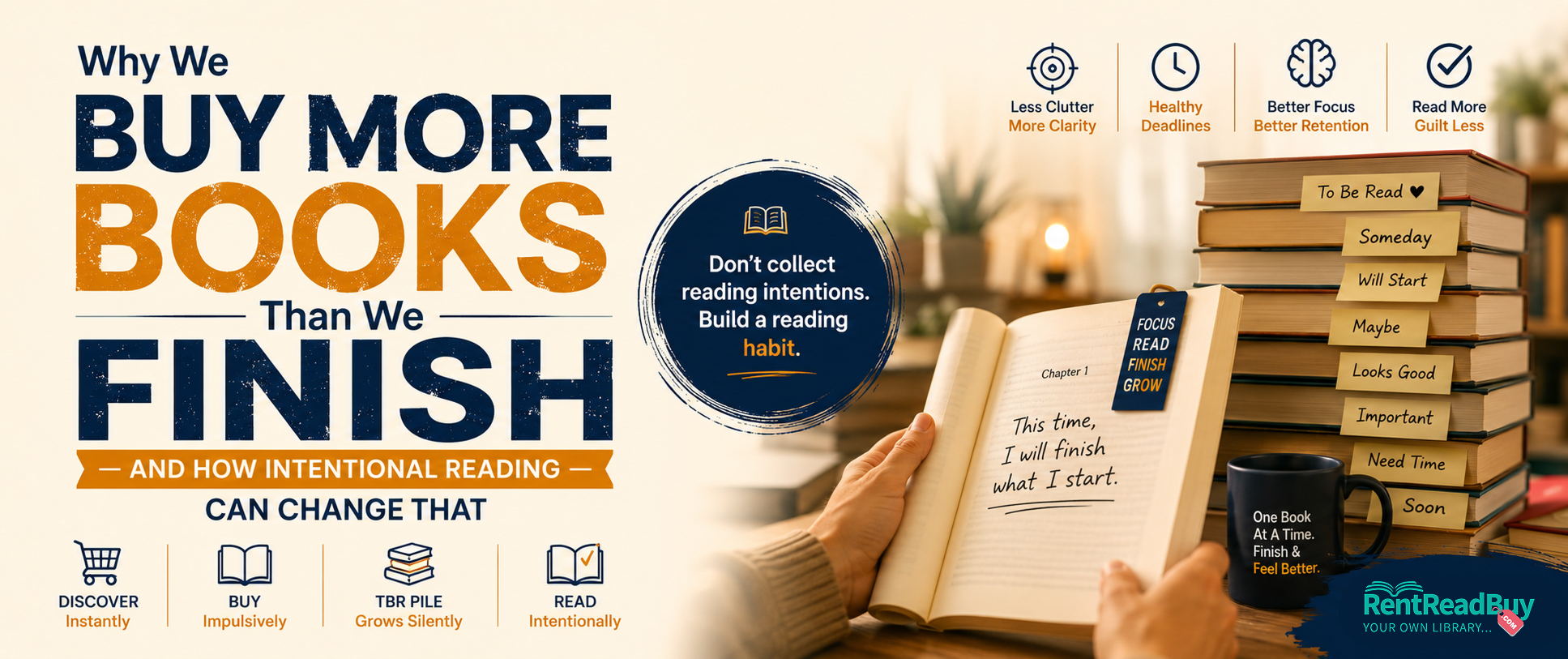
Why We Buy More Books Than We Finish — And How Intentional Reading Can Change That
Author: RentReadBuy Editorial Team
Published: 2026-07-17
Why does your TBR pile keep growing? Explore the psychology behind unread books and learn how renting first, reading intentionally and buying selectively can help you finish more books.
Intentional Reading
Why We Buy More Books Than We Finish — And How Intentional Reading Can Change That
You may genuinely love books, follow reading recommendations and plan to read more—yet still finish far fewer books than you bring home. That gap between discovery and completion is where the TBR pile begins.
A growing pile of unread books does not automatically mean that you are lazy, undisciplined or only pretending to be a reader. In many cases, it means something far more ordinary: discovering and acquiring books has become much easier than creating the time and routine required to finish them.
A recommendation can reach you through Instagram, YouTube, a podcast, a WhatsApp group, a friend or a book fair within seconds. Buying the book may take only a few taps. Reading it still asks for something that technology cannot deliver instantly: sustained attention.
Discovering a book creates curiosity. Buying it creates anticipation. Only reading it creates understanding.
That distinction is the key to understanding why bookshelves grow faster than reading habits—and why renting first can sometimes be a more practical way to explore books before deciding which ones deserve a permanent place in your life.
Book discovery is growing faster than reading time
Readers today have access to an extraordinary discovery system. Bookstagram posts, creator recommendations, online reviews, reading communities, newsletters and bestseller lists constantly introduce us to new authors and ideas.
This is not necessarily bad. Social platforms and reading communities can make books more visible, help independent writers find audiences and turn reading into a shared cultural experience. The challenge begins when recommendations arrive much faster than we can act on them.
Discover
A reel, review, podcast or friend makes a book feel immediately relevant.
Acquire
Buying feels quick, satisfying and connected to the person we want to become.
Complete
Reading requires repeated time, attention and a reason to return after the initial excitement fades.
We often treat these three stages as though they are one achievement. They are not. A saved recommendation is not a reading plan. An ordered book is not knowledge gained. A shelf full of respected titles does not automatically create a reading practice.
What the reading data actually tells us
Reliable data does not tell us exactly how many purchased books remain unread. It does, however, show that reading is highly uneven and that typical reading activity can be much lower than impressions created by highly active readers online.
A Pew Research Center survey conducted in October 2025 found that 75% of U.S. adults had read all or part of at least one book in the previous 12 months, while 25% had not read any book during that period. The survey covered 8,046 adults. Because it measures reading all or part of a book, it should not be treated as a direct measure of completed books.
Time is another important part of the picture. According to the U.S. Bureau of Labor Statistics, people aged 15 and above spent an average of about 17 minutes per day reading for personal interest in 2024. The data is American rather than Indian, but the practical tension is widely recognisable: many people value reading while struggling to create regular time for it.
Important context: These figures do not prove that people are buying books only for appearance, nor do they measure how many purchased books are unfinished. They show that reading time and reading volume are limited for many adults—a reality worth considering before every new purchase.
India is not losing interest in books
It would be misleading to turn this discussion into another claim that “people no longer read.” India continues to show substantial public enthusiasm for books.
The 2026 International Kolkata Book Fair reportedly attracted approximately 32 lakh visitors and generated about ₹26.4 crore in book sales. The New Delhi World Book Fair 2026, organised by the National Book Trust and India Trade Promotion Organisation, brought together more than 1,000 publishers and planned hundreds of events for readers, authors and publishing professionals.
At the same time, book clubs, public reading groups and social-media communities are helping younger readers make reading more visible and social. This is encouraging. It means India’s opportunity is not simply to convince people that books matter. It is to help existing enthusiasm turn into sustained and enjoyable reading.
The problem is therefore not that readers have stopped discovering books. The problem is that discovery can produce more intentions than our schedules can support.
When a TBR list becomes a guilt pile
TBR means “to be read.” At its best, a TBR list is useful. It remembers titles you might enjoy and prevents good recommendations from disappearing.
But when recommendations arrive faster than reading time, the list can change character. It stops feeling like a menu of possibilities and begins feeling like a collection of postponed intentions.
The TBR guilt cycle
The guilt is often subtle. It is not the feeling that you have completely failed. It is the quieter feeling of “I meant to read that.” A bookshelf can gradually become a visible record of plans that never found space in the calendar.
This should not become another reason to judge yourself. Guilt rarely builds a lasting reading habit. A better response is to understand the system that keeps producing the pile.
Why buying a book feels like progress
A book is more than paper and print. It represents a possibility.
Buying Deep Work can make us feel connected to a more focused future. Buying Atomic Habits can feel like the beginning of a disciplined routine. Buying a respected classic can make us feel closer to becoming the thoughtful reader we imagine ourselves to be.
The purchase delivers an immediate emotional reward: anticipation. The benefits of reading arrive much more slowly. They require opening the book repeatedly, continuing after the novelty fades and making room for it alongside work, family, travel, entertainment and rest.
The purchase is made under today’s excitement. The reading responsibility is handed to tomorrow’s schedule.
That future schedule is usually imagined generously. We picture a quieter weekend, an uninterrupted evening or a new routine that has not yet been created. When the future arrives, the same responsibilities are still there—and the book waits.
Why enthusiasm fades after the first few chapters
Many unfinished books follow a familiar pattern. The book is selected during a moment of high motivation. The first few pages feel fresh. Then the initial excitement settles, the ideas become more demanding or another activity takes priority.
This does not necessarily mean the book is poor. It means motivation was responsible for starting, but no repeatable system was created for continuing.
Reading habits survive the decline in excitement when they have simple cues: a regular time, an accessible book, a manageable daily target and permission to progress slowly.
For a deeper look at building consistent routines, read Small Habits, Big Results: How Atomic Habits Teaches the Power of Daily Improvement.
Too many unread books can create decision friction
A large personal library can be joyful and meaningful. But a large number of books competing to become your next read can also make starting harder.
One title feels useful for work. Another promises personal growth. A third is the novel everyone is discussing. Each choice appears important, and choosing one means temporarily postponing all the others.
The practical solution is not necessarily to remove every book. It is to reduce the number of active decisions. Keep a broad library if you enjoy one, but maintain a separate “read next” list containing no more than two or three titles.
How renting changes the reading decision
A book you own can remain unread indefinitely. That freedom is valuable when a title is meant for reference, annotation or rereading. But it can also remove any natural point at which you must decide what to do with it.
Renting gives the decision a defined window. Instead of “I will read it someday,” the reader knows that the book will eventually need to be completed, renewed or returned. For some readers, that modest external structure makes it easier to prioritise one title at a time.
Renting can also reduce the cost of experimentation. A bestselling book may not suit your preferences. A popular author’s style may not connect with you. A topic may sound useful but prove less relevant after the first few chapters.
When every experiment requires a permanent purchase, stopping can feel wasteful. When access is temporary, deciding that a book is not right for you can feel like useful information rather than failure.
Renting is not always better than buying
Intentional reading does not mean that buying books is wrong. Personal libraries can preserve knowledge, memories, annotations and books we want to revisit for years.
The better question is not “Should I always rent or always buy?” It is “What kind of relationship do I expect to have with this book?”
Rent first when...
- You are trying a new genre or author.
- You expect to read the book only once.
- You are unsure whether a popular recommendation suits you.
- You want to reduce cost and permanent clutter.
- You are rebuilding a reading routine one book at a time.
Buy when...
- You expect to reread or reference it regularly.
- You want to highlight, annotate or personalise the copy.
- The book has lasting academic or professional value.
- It carries personal, emotional or collectible meaning.
- You already know that it deserves a permanent place on your shelf.
Rent for discovery. Buy for permanence.
The READ framework for intentional reading
A sustainable reading habit does not require a dramatic challenge or an impressive yearly target. It needs a system that fits the amount of time you genuinely have.
Reduce active choices
Keep only one main book and, at most, one alternative in your immediate reading space.
Experiment before committing
Rent or preview unfamiliar books before making them permanent additions to your library.
Allocate a repeatable reading window
Choose a small period you can protect consistently rather than waiting for a completely free day.
Decide what deserves your shelf
After reading, decide whether the book should be returned, recommended, gifted or kept for future use.
What to do with the unread books you already own
Intentional reading begins with your current shelf, not your next order. You do not need to finish every book simply because you paid for it. You also do not need to remove books that bring genuine joy.
- Choose one active book. Put the remaining unread titles somewhere less visually demanding.
- Give it a realistic window. Two or three weeks may be more useful than an ambitious promise to finish it over one weekend.
- Read enough to make an informed decision. Not every book needs to be completed.
- Release books you no longer intend to read. Gift, donate or sell them through an appropriate local channel.
- Rent your next uncertain choice. Buy later when the book proves that it deserves to stay.
This approach removes the idea that every unfinished book is a personal debt. Some books teach us through completion. Others teach us that they are not the right book for this stage of our life.
Try this 30-day reading reset
How RentReadBuy supports intentional reading
RentReadBuy is designed around a simple idea: readers should have flexible ways to access books according to how they intend to use them.
You can rent a title when you are exploring an author, genre or subject. You can return it after reading. And when a book becomes something you want to annotate, reference, reread or preserve, buying it can be the right next decision.
This is not about replacing ownership. It is about making ownership more meaningful.
Build a reading life, not just a reading collection.
Choose one book intentionally. Rent when you want to explore. Read without forcing every title to become permanent. Buy the books that truly earn their place on your shelf.
Discover freely. Rent thoughtfully. Read completely. Buy intentionally.