Your Child Starts Books but Never Finishes Them? 7 Reasons and What Parents Can Do
Author: RentReadBuy Editorial Team
Published: 2026-07-28
Children often need to explore several genres, authors and formats before discovering what genuinely excites them. Renting makes that experimentation more affordable and reduces the pressure to finish a book simply because it was purchased.
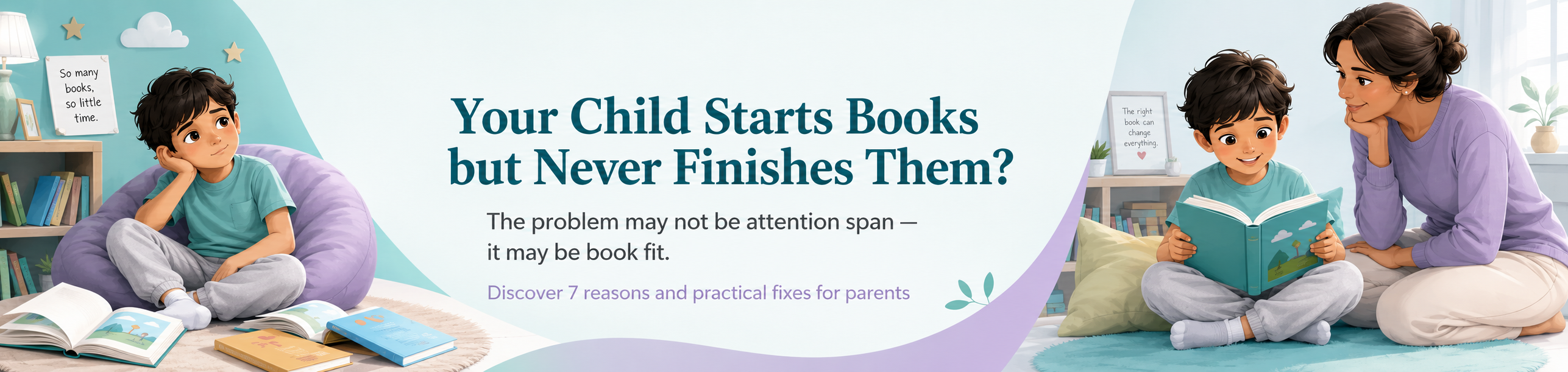
A child opens a new book, reads a few pages and leaves it on the table. A second book is started the next week and meets the same fate. Soon, parents begin to worry: Does my child have a short attention span? Do they dislike reading? Should I insist that they finish?
An unfinished book does not automatically mean that a child is lazy, distracted or incapable of becoming a reader. More often, it is useful feedback. The subject may not interest them, the reading level may be too demanding, the format may feel intimidating or the book may have been chosen without their involvement.
Quick answer: When a child repeatedly starts books but does not finish them, first check the fit between the child and the book. Match the subject to the child’s interests, reduce unnecessary reading difficulty, offer two or three formats, keep the reading session manageable and allow an unsuitable book to be paused without shame.
What parents should remember
- Book completion is not the only measure of reading progress.
- Interest, reading level and format all affect whether a child continues.
- Choice can increase ownership, but children still benefit from a small, suitable selection.
- Short, illustrated or humorous books are valid reading-not a lesser form of it.
- A repeated pattern across every kind of reading may deserve a conversation with the child’s teacher or another qualified professional.
The concern is timely. The UK-based National Literacy Trust reported that 36.1% of children and young people aged 8–18 enjoyed reading in their free time in 2026, a modest rise from 32.7% in 2025 but still a low level overall. Its work on book choice also highlights freedom of choice and connection to existing interests as important drivers of reading motivation. Although the survey is UK-based, the practical lesson is relevant to families everywhere: children are more likely to engage when reading feels personally meaningful.
What does an unfinished book actually tell you?
Parents often treat finishing as proof of discipline. But reading for pleasure is not the same as completing assigned schoolwork. An unfinished book can reveal useful information about the child’s preferences, confidence and current reading needs.
Instead of asking only, “Why did you stop?”, try three gentler questions:
- What part did you enjoy, even a little?
- What made you want to stop?
- What would make the next book easier or more exciting?
These questions turn abandonment into information rather than failure. The answers usually point towards one or more of the following seven reasons.
Seven reasons children start books but do not finish them
1. The book does not match the child’s current interests
A book can be popular, educational and age-appropriate yet still be a poor personal match. A child fascinated by football may not immediately connect with a slow fantasy story. Another child may avoid fiction but happily read about animals, space, inventions or real people.
What to try: Begin with the child’s existing curiosity. Ask what they watch, draw, collect, talk about or repeatedly ask questions about, and use those interests as a bridge into reading.
2. The reading level creates too much friction
A child may understand the general idea but struggle with dense paragraphs, unfamiliar vocabulary or long sentences. When too much effort is spent decoding individual words, the story loses momentum.
What to try: Ask the child to read a short section and explain what happened in their own words. Frequent confusion, repeated rereading or visible frustration may mean the book is better suited to shared reading or should be saved for later.
3. The format feels heavier than the story needs to be
Some children are discouraged by small type, long chapters or pages with no visual breaks. This does not mean they cannot handle meaningful ideas. They may simply engage better through illustrations, diary-style layouts, comics, graphic novels, short chapters or well-designed nonfiction.
What to try: Offer the same kind of subject in two different formats for example, a traditional chapter book and a fully illustrated story and observe which one the child willingly returns to.
4. The book was selected for the child, not with the child
Adults naturally want to guide children towards useful books, but a title can start feeling like homework when the child has no role in choosing it. Choice supports a sense of ownership, especially when the options have already been screened for suitability.
What to try: Present two or three appropriate books and let the child make the final selection. Avoid offering an entire shelf at once, which can turn choice into overwhelm.
5. The story takes too long to become rewarding
Some stories build slowly. Experienced readers may wait for the plot to develop, while a developing reader often needs an earlier reason to continue a mystery, a funny incident, a striking fact, a relatable problem or a clear goal.
What to try: Read the opening together, preview the back-cover description or choose a book with shorter chapters and a stronger early hook. Do not reveal the whole plot; simply help the child find the question the story is asking.
6. Reading has become associated with correction or performance
If every reading session includes constant pronunciation correction, comprehension testing or comparison with another child, the experience can become stressful. The child may stop to avoid being evaluated rather than because the story lacks appeal.
What to try: During pleasure reading, respond first as a fellow reader. Ask what was funny, strange, surprising or worth discussing. Correct only when the child asks for help or when misunderstanding prevents comprehension.
7. The reading routine asks for too much, too soon
A child who is rebuilding confidence may resist a target such as “finish one chapter every day” before the habit exists. Long sessions can make even a suitable book feel demanding.
What to try: Start with a short and predictable window perhaps ten or fifteen minutes and stop while the experience is still positive. A child who wants to continue for five more minutes is building a healthier habit than one who is forced to complete a fixed page count.
How can you identify the real barrier?
| What you notice | Possible reason | What to test next |
|---|---|---|
| The child reads easily but says the book is boring | Interest mismatch or slow opening | Try humour, mystery, sport, animals or another stated interest |
| The child loses the meaning of each paragraph | Reading level may be too demanding | Choose shorter sentences, larger text or shared reading |
| The child likes the story when someone else reads it aloud | Independent decoding is creating friction | Alternate pages or continue as a read-aloud |
| The child repeatedly chooses comics or illustrated books | Visual format supports engagement | Respect the format and gradually widen the selection |
| The child stops after being questioned or corrected | Reading feels like assessment | Use lighter conversation and fewer interruptions |
Use the Fit–Friction–Format check before choosing the next book
Before deciding that a child “does not like reading,” check three things:
Fit
Does the subject match the child’s interests, maturity and current reading confidence?
Friction
Are vocabulary, sentence length, chapter size or page density making reading unnecessarily difficult?
Format
Would illustrations, diary entries, short stories, nonfiction, comics or shared reading work better?
This check prevents parents from treating every abandoned title as an attention problem. Sometimes changing only one factor such as moving from dense chapters to an illustrated format is enough to transform the experience.
For a broader age-wise selection guide, read How to Choose the Right Books for Kids by Age.
Should children be allowed to stop reading a book?
Yes when the book is being read for pleasure and is clearly a poor fit. Allowing a child to pause an unsuitable title can protect curiosity and make room for a better choice. It also teaches an important reading skill: noticing what helps or prevents engagement.
That does not mean abandoning every book at the first difficult page. Use a simple “try, discuss, decide” approach:
- Try: Read a manageable opening section, independently or together.
- Discuss: Identify whether the problem is interest, difficulty, format or timing.
- Decide: Continue, read it together, pause it for later or choose another book.
Important distinction: This advice applies to voluntary reading for enjoyment. Assigned school reading may have a different purpose. In that situation, help the child break the task into smaller sections and discuss persistent difficulty with the teacher.
A practical seven-day reset for a child who keeps abandoning books
| Day | Action | What you are learning |
|---|---|---|
| Day 1 | Ask what the child likes outside reading games, animals, sport, humour, mysteries or real-life facts. | Current interests |
| Day 2 | Offer three suitable books in different formats. | Preferred presentation |
| Day 3 | Read for ten minutes without correcting or testing. | Natural engagement |
| Day 4 | Try shared reading or alternating pages. | Whether decoding is the barrier |
| Day 5 | Ask one open question: “What do you think might happen next?” | Story connection |
| Day 6 | Let the child continue, switch or pause without criticism. | Choice and ownership |
| Day 7 | Review the Fit–Friction–Format pattern and choose the next title accordingly. | A repeatable selection method |
When screens are also competing with the reading routine, use the practical steps in How to Reduce Screen Time in Children Without Daily Battles.
Three RentReadBuy books that offer different ways into reading
No single title is right for every child. These verified RentReadBuy options demonstrate three useful entry points: accessible short stories, illustrated humour and plot-driven mystery. Availability can change, so check the book page before ordering.
1. The 7 Habits of Happy Kids by Sean Covey
Best starting point for: Younger readers who benefit from pictures, familiar characters and shorter story units.
The book introduces its ideas through seven accessible stories featuring a recurring cast of characters. A child can experience a complete narrative in a smaller unit instead of facing one long, continuous plot.
View this book on RentReadBuy2. Tom Gates #14: Biscuits, Bands and Very Big Plans by Liz Pichon
Best starting point for: Children who enjoy humour, doodles, school-life situations and visually varied pages.
This fully illustrated title uses drawings, lists and comic observations to keep pages visually active. It can feel less intimidating than a traditional text-heavy novel while still supporting sustained reading.
View this book on RentReadBuy3. Hardy Boys 19: The Disappearing Floor by Franklin W. Dixon
Best starting point for: Developing chapter-book readers who are motivated by clues, danger, puzzles and forward-moving plots.
The mystery gives readers a clear reason to continue: they want to discover how the strange clues connect. Plot-driven books can work well for children who lose interest when a story takes too long to establish a goal.
View this book on RentReadBuyWhy renting first can help children find the right book
Finding the right book often requires experimentation. A child may enjoy illustrated humour today, mysteries next month and factual books after developing a new hobby. Buying every trial title can become expensive and may add pressure to finish simply because money was spent.
Renting allows families to:
- test different genres, authors and formats;
- rotate books as interests change;
- reduce the guilt attached to an unsuitable choice;
- learn what the child willingly returns to; and
- buy the favourites that genuinely deserve a permanent place at home.
Explore the RentReadBuy book library, or learn how renting and returning books works.
When might a child need additional reading support?
A child abandoning an occasional book is normal. Consider seeking further guidance when difficulty appears consistently across many suitable texts and also affects schoolwork or everyday confidence.
It may be helpful to speak with the child’s teacher or another qualified professional when the child:
- struggles to understand even short, age-appropriate passages;
- frequently loses their place or avoids reading aloud because it causes distress;
- reports recurring headaches, eye strain or difficulty seeing the text;
- shows a sudden decline in reading or school participation; or
- becomes persistently anxious or upset around reading tasks.
Responsible note: This article offers general reading-habit guidance and does not diagnose attention, learning or vision-related conditions. A teacher, paediatrician, optometrist or qualified reading specialist can help assess persistent concerns in context.
Final thought: look for the pattern, not the unfinished pile
Your child may not dislike reading. They may simply not have met the right combination of subject, challenge and format yet.
Treat each unfinished book as a clue. Notice what the child enjoyed, remove unnecessary friction, offer a small amount of meaningful choice and try again. The goal is not to produce a perfect completion record. It is to help the child discover the kind of reading they want to continue.
Help your child discover a book worth continuing
Explore different genres and formats without buying every title before you know what fits.
Explore the Book LibraryHelpful references: National Literacy Trust, Children and young people’s reading in 2026; Book Choice: empowering pupils to read for pleasure; and Institute of Education Sciences, Developing Student Motivation to Read.